RFK Jr oversaw nearly $800K in funding for research linked to Russian plague lab: Report
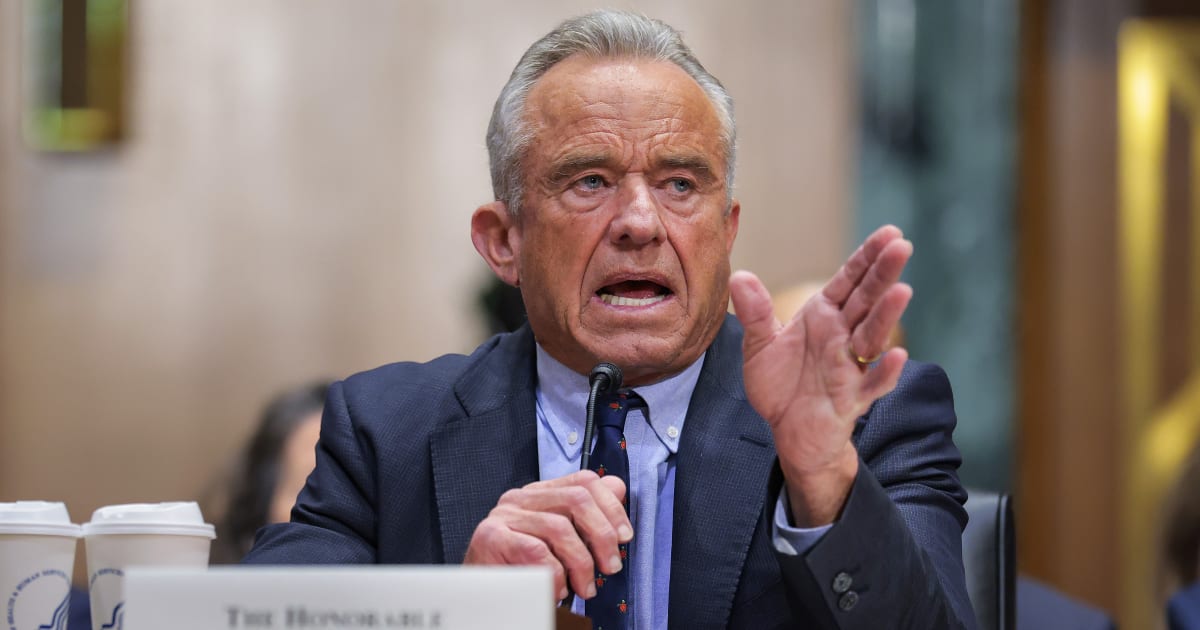
WASHINGTON, DC: Health and Human Services Secretary Robert F Kennedy Jr is under fire after nearly $800,000 in federal funds went to a research project tied to a Russian state-run institute.
The institute has ties to a facility recently linked to a suspected plague outbreak. The National Institutes of Health awarded the money to the University of Illinois Urbana-Champaign in 2025 and 2026.
Federal funding went to research involving Russian institute
According to a new investigation by animal testing watchdog White Coat Waste (WCW), the National Institutes of Health awarded $779,689 to the University of Illinois Urbana-Champaign in 2025 and 2026 for research conducted in partnership with Russia’s state-run Institute of Cytology and Genetics.
Federal records the group obtained and reported on Wednesday show the project received $389,943 in July 2025 and another $389,746 in September 2026.
The Russian Institute of Cytology and Genetics worked with the Irkutsk Anti-Plague Research Institute on plague studies, and now people are paying close attention to Irkutsk after a tragedy in one of its labs. Daria Shipilova, a 28-year-old researcher, got sick after a test tube broke on September 25.
Her illness turned into severe pneumonia, and she didn’t survive. After her death, Russian officials put almost 200 people under medical watch.
☣️ IRKUTSK UPDATE: WHO Director-General Tedros Adhanom Ghebreyesus said the organization has formally requested additional information from Moscow to clarify three unresolved issues: the cause of Daria Shipilova’s severe pneumonia, the pathogen that prompted Russian authorities to implement extensive public-health measures, and media reports that another institute employee developed pneumonia of undetermined cause. “Timely, complete and transparent information sharing under the International Health Regulations is essential to clarify conflicting reports and enable an accurate assessment of potential public health risks,” Tedros said. Russia has told the WHO that no plague case has recently been registered in Irkutsk Oblast. According to Tedros, Russian authorities conducted an epidemiological investigation, implemented preventive and control measures, traced and tested contacts, and found no high-threat pathogens among them. Medical observation of all identified contacts has now been completed. The WHO says it remains in contact with Russian authorities and has offered technical assistance. The reference to a second employee is particularly important because separate reports of a “second death” have circulated today. Those claims remain unverified. Tedros did NOT say a second person had died or that the second employee has plague; he said the WHO is seeking clarification about reports of another employee with pneumonia of undetermined cause. 🇺🇲 The international response is also moving higher politically. President Trump said today that he has a call scheduled with Vladimir Putin to discuss the possible pneumonic-plague case, while U.S. intelligence continues examining the incident. Secretary of State Marco Rubio has separately urged Moscow to provide more information, saying it would be “reckless” to speculate without complete data. Inside Irkutsk, precautionary measures have included hospital restrictions, medical observation of roughly 200 contacts, isolation and testing of institute employees, and screening and visitor restrictions at a maternity hospital. Russia continues to describe Shipilova’s death as “pneumonia of unknown etiology” and denies that an accident involving pathogenic material occurred. There is still no confirmed plague diagnosis for Shipilova, no confirmed secondary plague transmission and no credible evidence of a plague-related lockdown or cases in St. Petersburg. But the central question has now become more specific: if Russia says no plague was detected, the WHO wants to know what pathogen prompted the public-health response, and what explains reports of another institute employee with undetermined pneumonia. https://t.co/lGUyLcnp2s
— The Tectonic (@thetect0nic) October 6, 2026
Russian officials haven't said outright that Shipilova died from the plague. US authorities are keeping an eye on things, and President Donald Trump mentioned on Tuesday that he planned to speak with Russian President Vladimir Putin about concerns over the outbreak.
As for the NIH-funded project, it doesn’t focus on plague at all. Its main goal centers on studying the genetics behind social behavior in foxes. Researchers have teamed up with the Russian institute to carry out this work.

Funding raises questions over US-Russia scientific ties
Federal funding has raised eyebrows, since it kept going even after the Biden administration told agencies in 2022 to pause scientific partnerships with Russian government institutions, right after Russia invaded Ukraine.
White Coat Waste, a group known for criticizing taxpayer-funded animal experiments in Russia, says Kennedy's department shouldn’t have kept supporting the collaboration.
A 28 year old lab tech at the Anti-Plague Institute in Irkutsk, called Daria Shipilova, was admitted to the district hospital in Shelekhov with severe pneumonia on 29th Sept and died on 2nd Oct. She reportedly told medics she'd broken a tube of live Yersinia pestis. https://t.co/d9xmIZNKWK
— TUA Research (@TUA_Research) October 6, 2026
The group pointed out that this new funding highlights what they see as a real issue: US taxpayers are bankrolling research that involves Russian government institutions.
Their discovery comes at a time when Washington is keeping a close eye on Russia, especially after the recent lab incident and Shipilova’s death.
Almost $780,000 was split between two payments, with the second scheduled for September 2026. According to records from White Coat Waste, the money ended up at the University of Illinois Urbana-Champaign for a research partnership.

Kennedy, who leads the Department of Health and Human Services, hasn’t been directly linked to the grant. The NIH, which falls under HHS, awarded the funding. White Coat Waste uncovered this through its investigation and confirmed it with federal records.