World War II hero, 107, relives D-Day as he reads letter written days before Normandy invasion
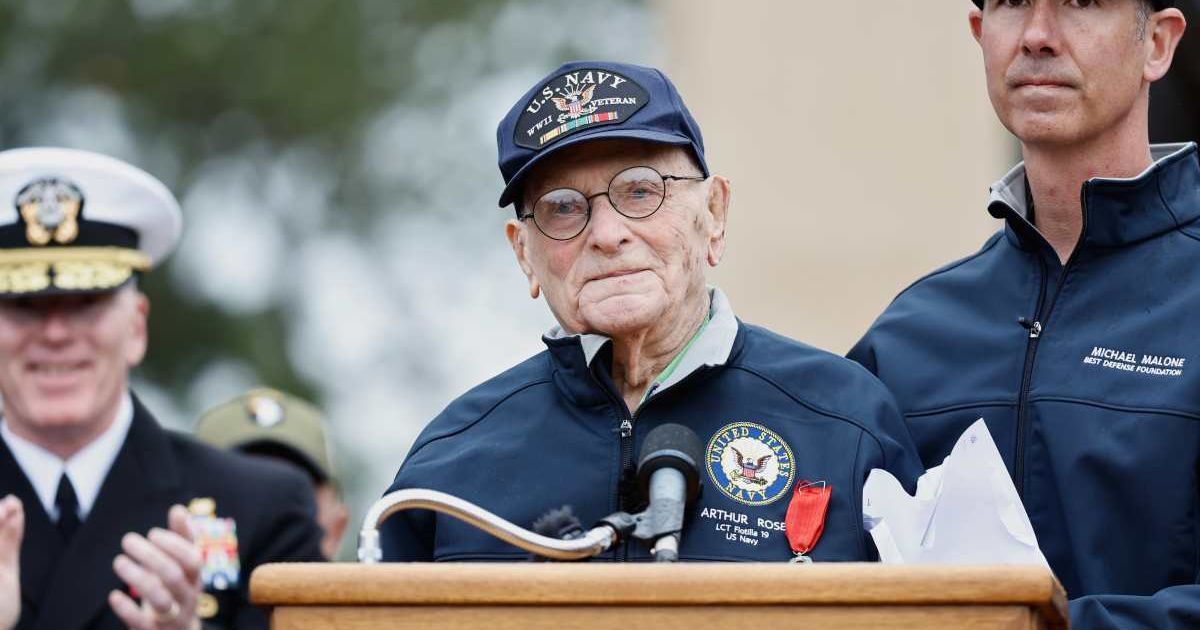
NORMANDY, FRANCE: World War II veteran Arthur Rose took those gathered in Normandy back to one of the most pivotal moments in modern history when he read aloud a personal letter he wrote just days after D-Day in June 1944.
Speaking at a ceremony on Saturday, June 6, marking 82 years since the Allied invasion of Normandy, Rose shared vivid memories of the days leading up to the operation, the uncertainty that surrounded it, and the emotions he experienced as thousands of troops prepared to cross the English Channel.
Moment d’émotion quand le vétéran du débarquement 🇺🇸 Arthur Rose,107 ans, relit son courrier et exprime sa gratitude pour l’honneur d’avoir été parmi les héros de 44, et remercié en fin de discours par notre ministre des armées. pic.twitter.com/mMyN9mLZa6
— Cadmos (@BelAmi06400) June 6, 2026
Arthur Rose recalls learning he would be part of D-Day
Reading from the letter addressed to his family, Rose explained that he never expected to be directly involved in the invasion.
"Dear mom and dad and kids, About a month before we landed, I had a feeling I might be part of the invasion. I couldn't quite believe, though, that I would," he read.
Rose admitted that he struggled to understand what role he could possibly play.
"I kept thinking, what could I possibly do in an invasion? Pull engines in the middle of a battle? I figured men like me would come along afterwards — after they cleared the wreckage and the damage had passed."
On D-Day anniversary CBS spoke with 107-year-old vet Arthur Rose, who was a Navy lieutenant that day. "I love America. I think it's the savior of the world," he said
— Jason (@dcxr7) June 5, 2026
Sadly it’s true that many Americans would agree with the “savior of the world” sentiment. pic.twitter.com/dTWnHH2T9L
That assumption changed just weeks before the operation.
"But two weeks before D-Day, I was told I would go along and do whatever I could," he continued.
The veteran then described the enormous preparations taking place at the assault port, where countless ships filled the harbor.
"We had moved to the assault port. Thousands of ships and landing craft of every description filled the harbor."
According to Rose, activity never seemed to stop.
"Everyone worked day and night preparing fuel, provisions, ammunition and secret material. Everything was checked and rechecked and checked again. You can imagine the confusion and activity."
Arthur Rose describes moment troops learned about invasion date
One of the most powerful sections of the letter came when Rose recalled realizing the invasion was finally approaching.
He described the constant loading of supplies needed for troops once they reached France.
"Then came the day we began loading supplies for the invasion: food, blankets, ammunition, and all the countless things that would be needed once the men landed in France."
The preparations made it clear that something historic was about to happen.
"We knew then the invasion could not be far. Then came the word: D-Day will be June 6th."
Rose said the emotions he experienced at that moment were difficult to define.
On June 6, 2026, the American Battle Monuments Commission commemorated the 82nd anniversary of D Day with a ceremony at Normandy American Cemetery, honoring the service and sacrifice of U.S. military personnel and their allies who gave their lives during the Allied landings and… pic.twitter.com/DLm91HTJ6W
— ABMC (@usabmc) June 6, 2026
“I can't describe the feeling exactly. It wasn't fear, and it wasn't excitement."
Instead, he remembered a mixture of uncertainty and anticipation.
"Just a funny feeling — nervousness, expectancy, and wondering what was going to happen next."
The letter also described the difficult conditions at sea.
"Then we sailed. The sea was rough, windy, and miserable. I was seasick most of the time."
Like many others, Rose expected combat at any moment.
"Everyone expected bombing, submarines, battleships, and all hell to break loose at any moment."
When the initial attempt was postponed because of rough seas, he recalled feeling disappointed.
"But the first attempt was called off because the sea was too rough, and we returned to the harbor. That was a real letdown."
Arthur Rose remembers arriving near French coast
The veteran continued reading as he described the second attempt to reach France.
"The next day, we sailed again."
As Allied forces neared the coast, signs of battle became impossible to ignore.
"Near the coast of France, we could see flashes in the distance and hear the explosions continuously."
Rose said troops understood the dangers they faced.
D-Day: Invasion of Normandy [Real Footage in Colour] pic.twitter.com/ArMiGatrBw
— Voices of WW2 (@VoicesofWW2) June 6, 2026
"In went the landing craft. We expected terrible destruction, as there was shelling, and men died. But not all of us."
His letter then shifted to the work that followed once forces established a foothold.
"Then our work truly began: back and forth, day and night, bringing in equipment, medical supplies, and ammunition."
The coastline itself transformed before his eyes.
"What had once been just another stretch of French coast had suddenly become a vast harbor filled with hundreds of ships and thousands of men."
The description offered listeners a vivid image of the scale and speed of the Allied operation after troops landed.
Arthur Rose pauses as memories come flooding back
As Rose reached the closing lines of the letter, the emotional weight of the moment became evident.
Partway through the reading, he briefly stopped and looked up.
"I don't remember writing this," he said aloud, drawing smiles and quiet laughter from those gathered.
He then finished the letter exactly as he had written it more than eight decades ago.
"I will always be grateful to my commander for taking me along. Don't worry about me. I am well, and whole, and happy. Love, Art."