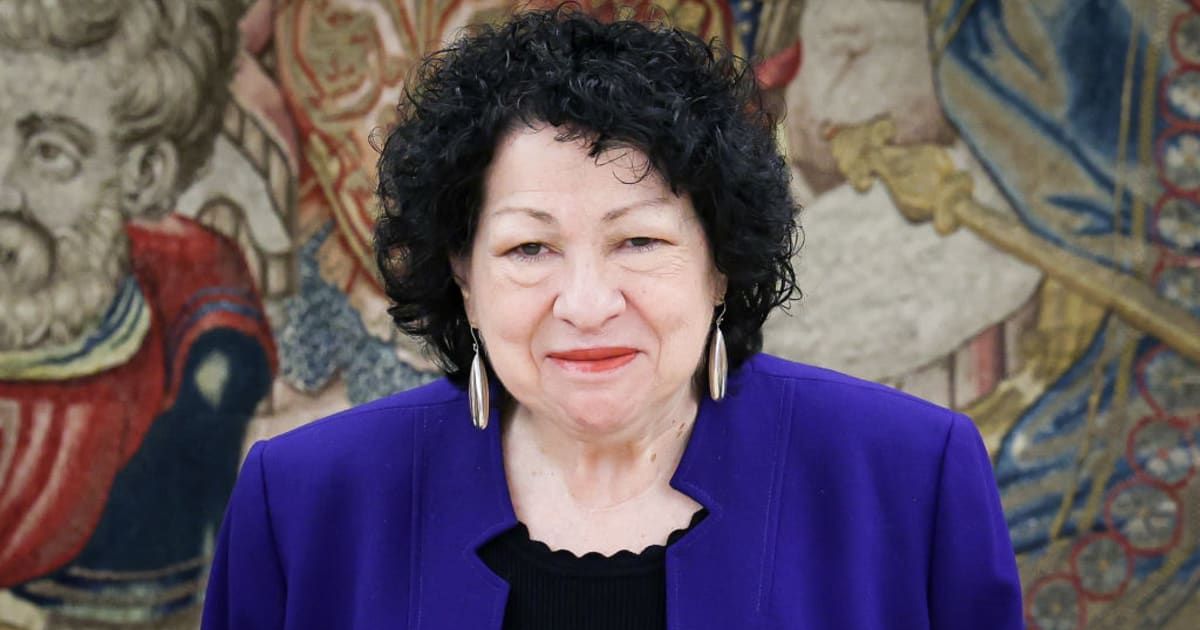
Justice Sotomayor blasts Supreme Court for ignoring discrimination finding in Alabama map case
Aided by Trump's hand-picked Supreme Court, Republicans are doing everything they can to take away the voices of Black and brown voters.
— Ken Martin (@kenmartin73) June 3, 2026
In the words of Justice Sotomayor, this decision "disregards both democratic values and the rule of law."
We will not roll over. https://t.co/AV3Nt3fZ3P
WASHINGTON, DC: Supreme Court Justice Sonia Sotomayor accused her colleagues of ignoring a lower court's finding of intentional racial discrimination in a high-stakes Alabama voting rights case.
Her dissent quickly sharpened criticism of the Supreme Court's recent voting-rights rulings. It also raised fresh questions about how the court's new legal standard fits cases where discriminatory intent has already been found.
Sonia Sotomayor challenges Callais reasoning
Writing alongside Justices Elena Kagan and Ketanji Brown Jackson, Sotomayor said the court's majority failed to confront what she described as a central fact in the case: a lower court had already determined Alabama intentionally diluted Black voting power through its congressional map.
"The majority's order grapples with virtually none of this," Sotomayor wrote.

The dispute stems from Alabama's effort to use a congressional map that a lower court found was intentionally designed to weaken the voting strength of Black residents. The Supreme Court allowed the state to use the redrawn map for this year's midterm elections in a 6-3 decision.
Sotomayor argued the majority did not meaningfully address the lower court's conclusion, even though, in her words, the "record is crystal clear."
She reserved some of her sharpest criticism for the court's reliance on its recent ruling in Louisiana v Callais. That decision made it significantly harder for plaintiffs to succeed in Voting Rights Act claims by requiring proof of intentional discrimination.
According to Sotomayor, the majority then used Callais to set aside a case where a court had already found discriminatory intent.
"Much of its reasoning rests on its assertion that, even as to the plaintiffs' Fourteenth Amendment claim, 'the District Court's analysis departed from Callais,'" she wrote. "That is wrong twice over."
Alabama map ruling sparks new scrutiny
Critics' ruling point to what they see as a growing tension between the court's demand for proof of intent and its handling of cases where such findings already exist.
Just days before the Supreme Court acted, a three-judge panel had blocked Alabama's preferred map, writing that it could not require voters to cast ballots under "a districting plan tainted by intentional race-based discrimination."
That same panel said Alabama's map was enacted with discriminatory intent after reconsidering the case in light of Callais.
The Supreme Court's conservative majority disagreed, saying the lower court had not properly applied Callais and other recent voting-rights decisions. The justices also said the panel failed to give Alabama lawmakers a presumption of good faith.
Sotomayor said the court instead chose to "disregard both democratic values and the rule of law."
In another passage, she warned that the majority had selected "a chaotic election" under a map that "intentionally discriminates against Black Alabamians" and that Alabama adopted in "unashamed defiance" of a previous court order.