Trump claims Strait of Hormuz as 'new US territory' and Iran warns they will 'correct his delusions'
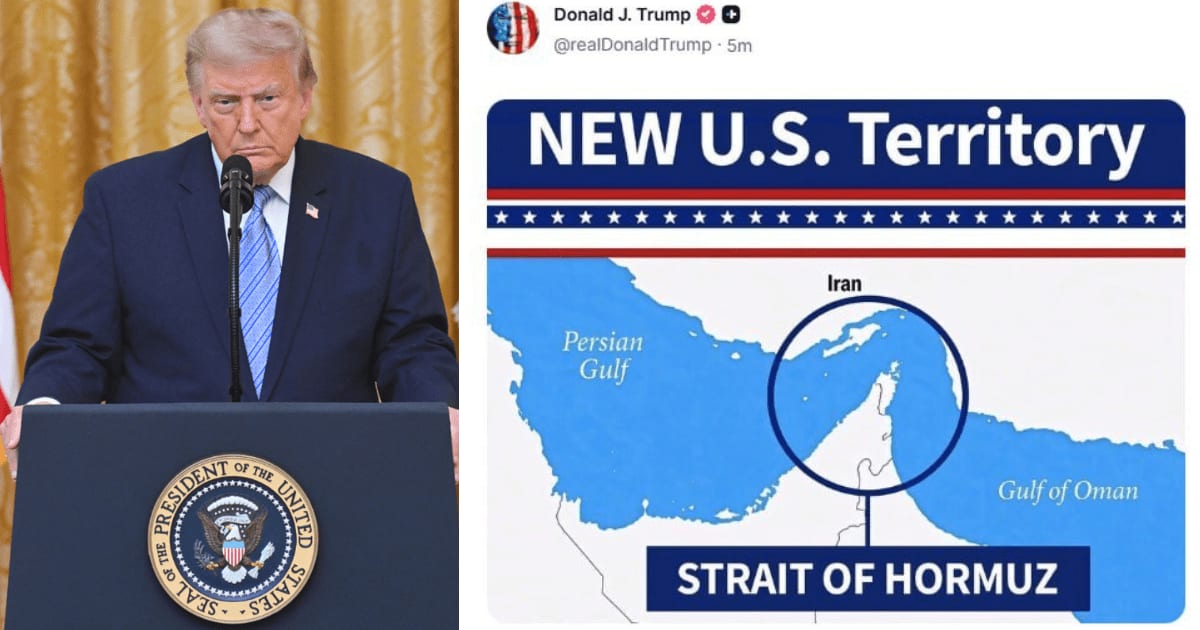
WASHINGTON, DC: President Donald Trump has escalated his confrontation with Iran over the Strait of Hormuz, sharing a map labeling the strategic waterway “NEW US TERRITORY” after previously saying he wanted to formally declare it part of the United States. Trump has also said the US has “total control” of the strait and that the American naval blockade remains in force.
In a separate post on Tuesday, Trump said there were “no talks or conversations going on, or scheduled” with Iran, while also saying the Strait of Hormuz was open and operating and that mines had been removed or detonated.
Trump asserts control over Hormuz
Trump’s latest map follows his earlier proposal to make the Strait of Hormuz US territory after what he described as an American takeover of control over the waterway.
The president has repeatedly linked the strait to his broader pressure campaign against Tehran. He has said the United States would become the “Guardian of the Hormuz Strait” and announced a blockade targeting Iranian shipping while saying other countries would retain access.
Trump has now said the naval blockade remains active while also describing the strait as open and operating. He has ruled out current or scheduled talks with Iran and said he does not plan to extend the June agreement.
The administration’s position leaves Trump’s “NEW U.S. TERRITORY” map as a political assertion rather than a formal change in the waterway’s international status.
Iran rejects Trump’s ownership claim
Iranian Deputy Foreign Minister Kazem Gharibabadi rejected Trump’s depiction of the Strait of Hormuz.
“The Strait of Hormuz has been Iranian, is Iranian, and will remain Iranian,” Gharibabadi said, directly rejecting the US president’s claim over the waterway.
همانطور که ترامپ نام خلیج همیشگی فارس را به صورت صحیح نوشت، به زودی توهمش درخصوص تنگه هرمز یا اصلاح می شود یا توهمات این متوهم را اصلاح خواهیم کرد. pic.twitter.com/gpxqnGK077
— Gharibabadi (@Gharibabadi) August 18, 2026
Gharibabadi also mocked Trump’s earlier remarks, saying that his “delusion” regarding the Strait of Hormuz would either be corrected or that Iran would correct it.
Iranian officials have repeatedly rejected US claims to control the strait. Tehran has maintained that Iran remains the guardian of the waterway and has tied its reopening to US concessions, including lifting the blockade and sanctions, releasing frozen Iranian assets and ending military operations.
Until US 'compensates' for MOU 'violations', NOT possible to restart talks — Iran’s FM Araghchi
— RT (@RT_com) August 9, 2026
Adds maritime route agreement with Oman does NOT mean Strait of Hormuz will be reopened
Opening 'contingent upon fulfilling a series of other conditions' pic.twitter.com/A56102zlx9
Iranian officials have also said the strait will remain closed until Washington meets conditions connected to the June agreement.
Hormuz dispute follows failed diplomacy
The latest exchange comes after the expiration of the 60-day period established under the June US-Iran memorandum of understanding.
The agreement included provisions for reopening the Strait of Hormuz and beginning negotiations over a broader settlement. The two sides have since remained divided over its implementation.
Trump said Tuesday that no talks were taking place or scheduled with Tehran, while diplomatic contacts involving regional mediators and US representatives have continued.
The dispute over Hormuz has therefore become closely tied to the broader breakdown in efforts to reach an interim agreement between Washington and Tehran.
What would a US claim actually do?
The Strait of Hormuz lies between Iran and Oman and is governed by an international legal framework covering navigation through international straits.
A US presidential declaration would not, by itself, transfer sovereignty over territory belonging to another country.
A presidential social-media post or declaration cannot simply erase the existing territorial claims of another country.
US constitutional practice also gives Congress an important role in territorial expansion. A 2026 Congressional Research Service review found that historical US territorial acquisitions have involved treaties, congressional legislation or both, with Congress playing a significant role in recognizing the addition of new territory.
The Supreme Court has also previously indicated that acquiring foreign territory falls within the treaty-making or legislative powers rather than being an ordinary presidential war power.
More importantly, even a US decision to claim sovereignty would not automatically make Iran or Oman surrender their own claims. Such a move would create a major international dispute rather than instantly changing the legal status of the strait.
The Strait’s existing legal status also distinguishes freedom of navigation from ownership. Ships have rights of passage through international straits, but that does not mean the waterway becomes the territory of the countries using it.
For now, Trump has publicly presented Hormuz as “NEW U.S. TERRITORY,” while Iran has rejected the claim and maintained its own position over the waterway.
The next political question is whether the dispute remains a public declaration or becomes part of Washington’s formal policy toward Tehran, with potential consequences for US-Iran negotiations, maritime tensions and any response from Congress, US allies or international institutions.