Space race and not minerals may be fueling Trump's quest for Greenland: Experts

NUUK, GREENLAND: Former US presidential adviser Dr Pippa Malmgren says geopolitical competition in space may be the driving force behind President Donald Trump’s interest in Greenland.
In a Bloomberg interview published on Monday, January 26, Malmgren pushed back on widespread analysis that Trump’s focus on Greenland was motivated chiefly by rare earth metals.
Greenland key to US space race ambition
“Yes, it has a value,” she said of the minerals, which are vital components in electronics and defense systems.
“But let’s remember that there are rare earth metals all over the place. It’s the refining that’s the issue. And Greenland is not going to be excited about having the toxic refining process happen there,” Malmgren said.
She added that while Greenland does have significant deposits of “particularly important” elements such as dysprosium, that alone “is still not enough for a business model.”
Instead, Malmgren pointed to the strategic importance of space infrastructure at high latitudes.
“So what are the bigger issues? I say, number one, the space race. And to do the space race, you need ground station links to satellites,” Malmgren, chief executive of Geopolitica Institute, added.
“The most effective location for that is the Arctic, which is why Svalbard in Norway, the Longyearbyen ground station, has such high importance. Right now, it's surrounded by NATO's ships guarding it because it's so critical. It’s like an umbilical cord for data from space to Earth to the subsea cable network,” she said.
She suggested that Greenland’s northern reaches could serve a similar role as a ground station hub.
“So one reason you can see why the United States wants at least the north of Greenland is to have the space base there become a ground station— a more important ground station, because right now there's only one single point of failure, which is Svalbard,” she told Bloomberg’s Merryn Webb.
Pituffik Space Base in focus
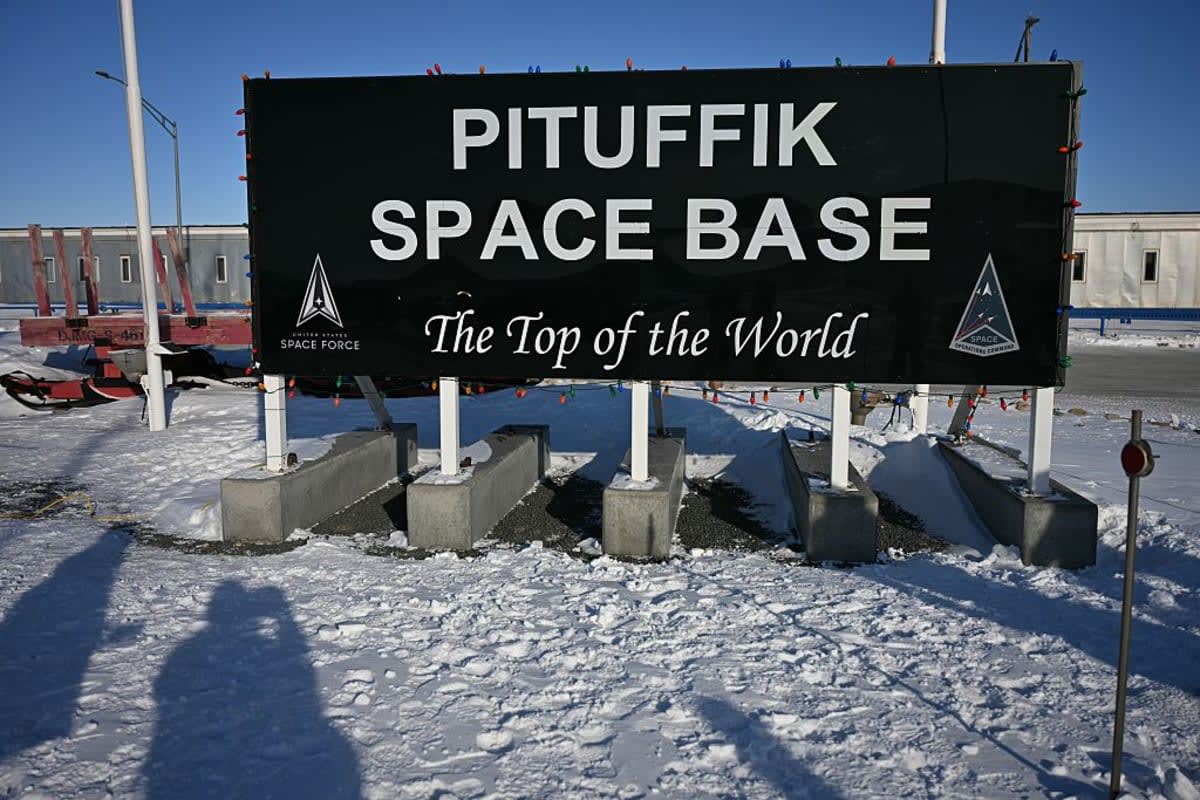
Greenland already hosts Pituffik Space Base, formerly Thule Air Base, in the far northwest of the island. Operated by the US Space Force under long-standing defense agreements with Denmark, Pituffik sits roughly 750 miles north of the Arctic Circle and remains America’s northernmost installation.
It supports missile warning, space surveillance, and satellite tracking missions and is considered a critical node for ballistic missile early warning systems and other space domain operations.
The base’s importance has only grown amid increased competition from Russia and China in the Arctic.
The US and its North Atlantic Treaty Organization (NATO) partners view a strong presence there as essential to monitoring missile and space activity over polar and near-polar orbits.
Greenland space base uses go beyond military surveillance
In a separate article for The Conversation, author Anna Marie Brennan noted that Greenland is at “the crossroads of two fast-shifting frontiers: a warming Arctic that will change shipping routes, and an increasingly militarized outer space.”
Former Cold War outposts like Pituffik have evolved into key parts of space surveillance networks, valuable for military reconnaissance and tracking satellites and debris in orbit.
“It’s not just about military surveillance,” Brennan wrote. Greenland’s geography also offers opportunities for high-latitude satellite launches and tracking, which could grow more important as private space companies expand operations and polar orbits become increasingly trafficked.